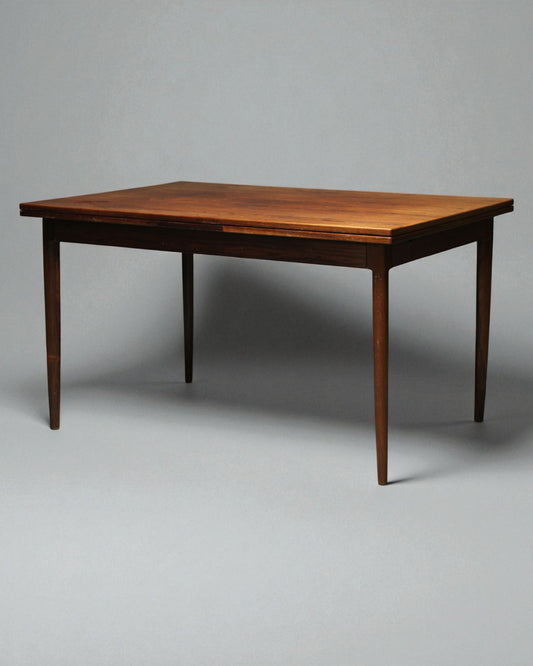
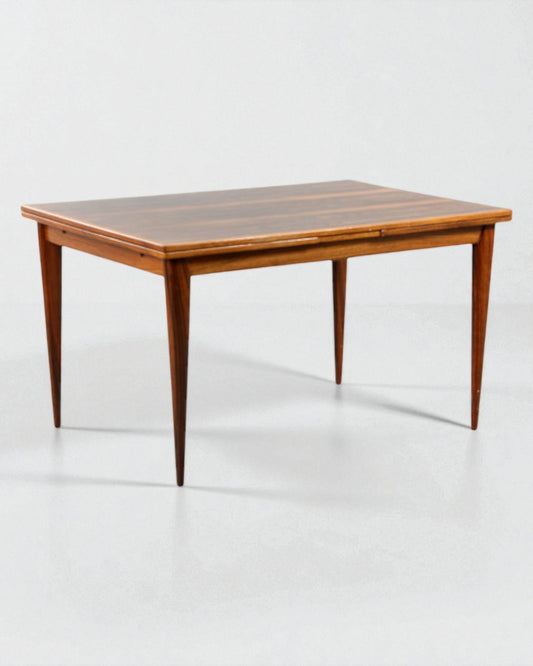
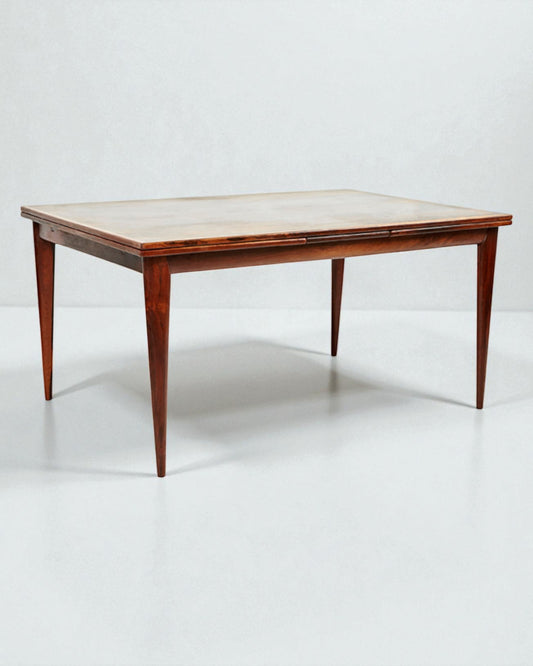
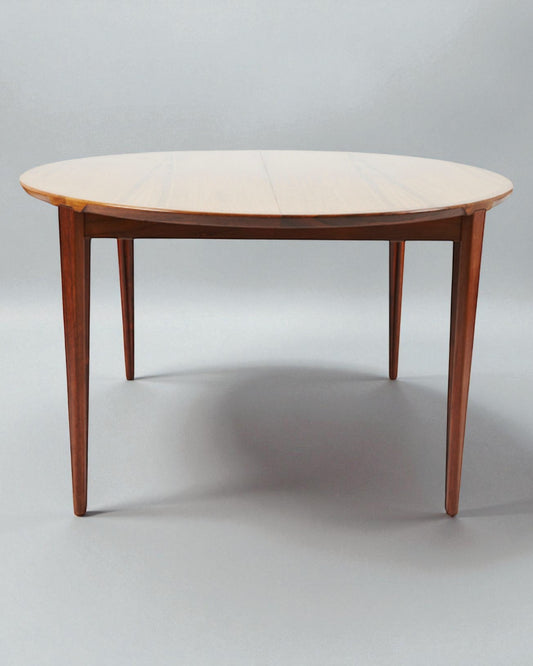
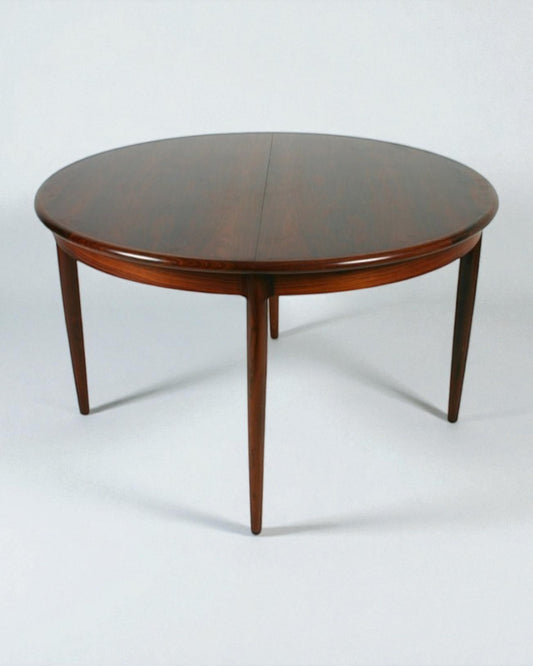
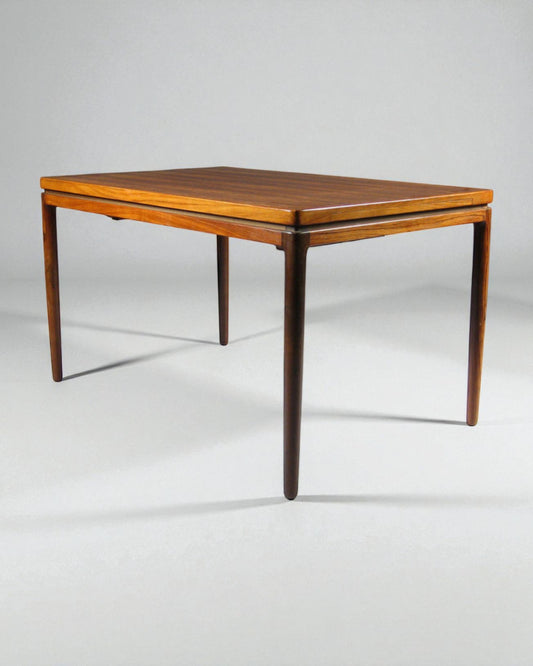
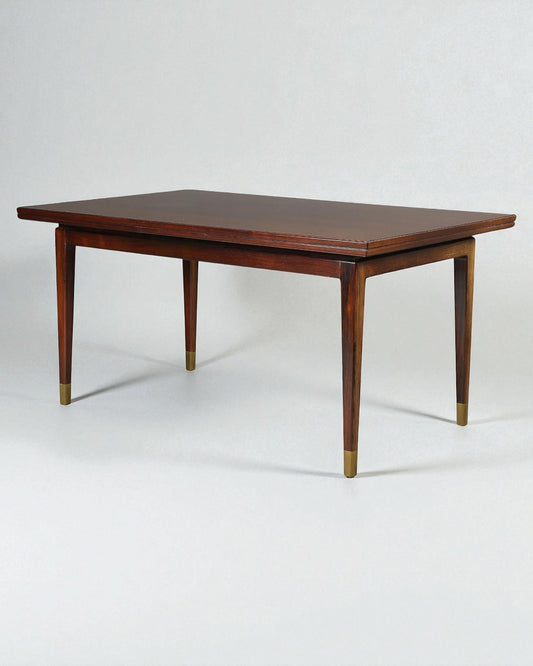
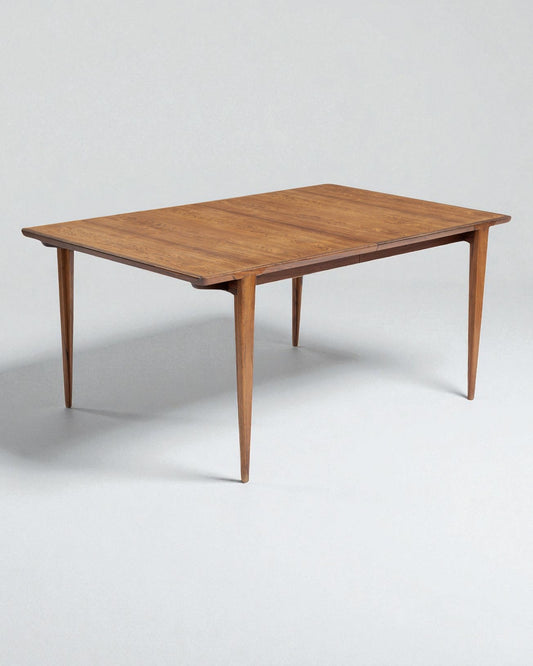
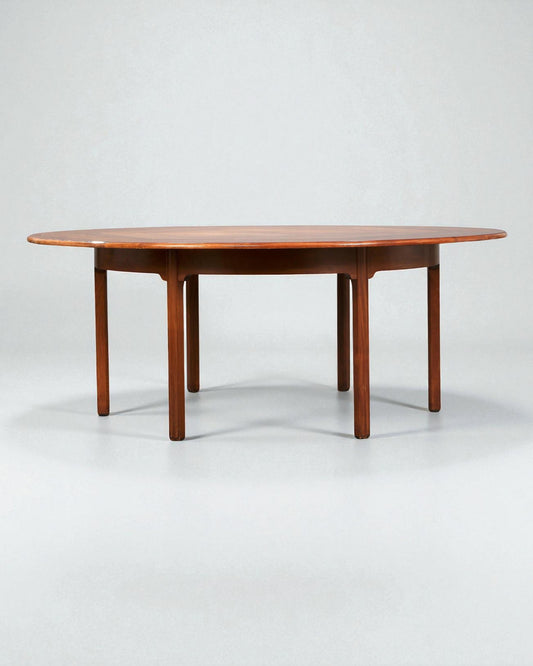
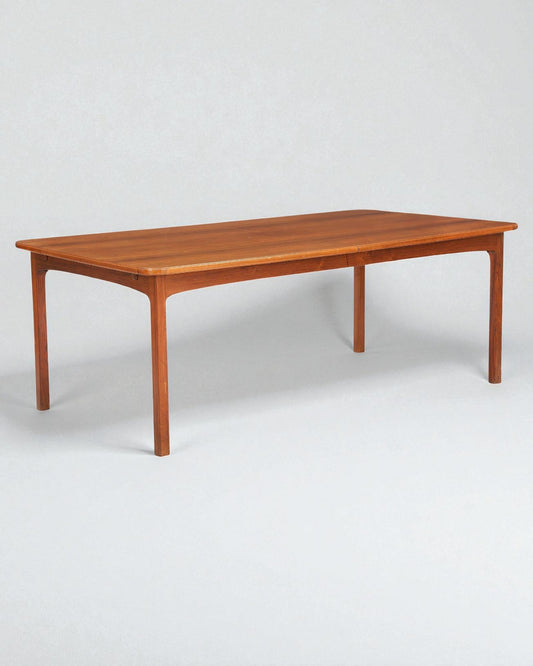
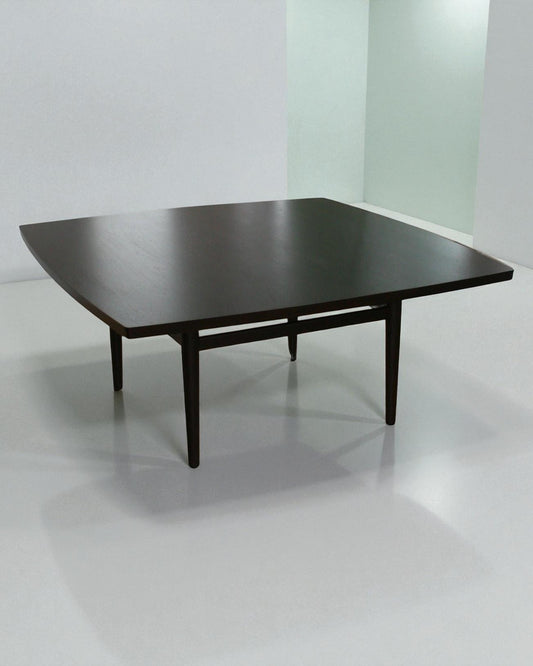
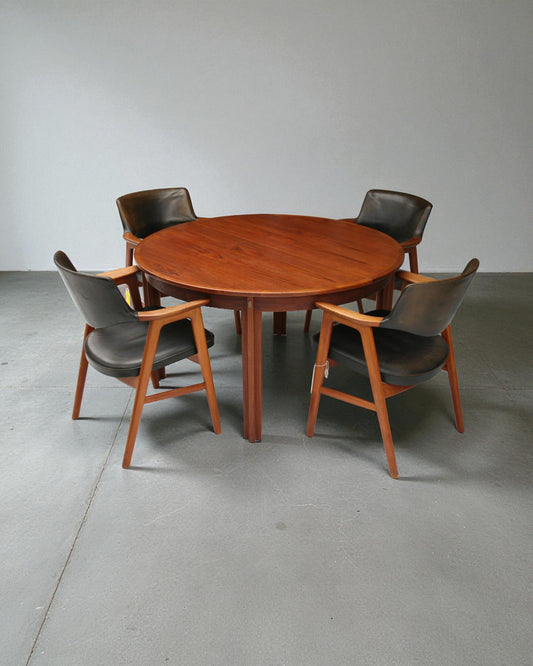
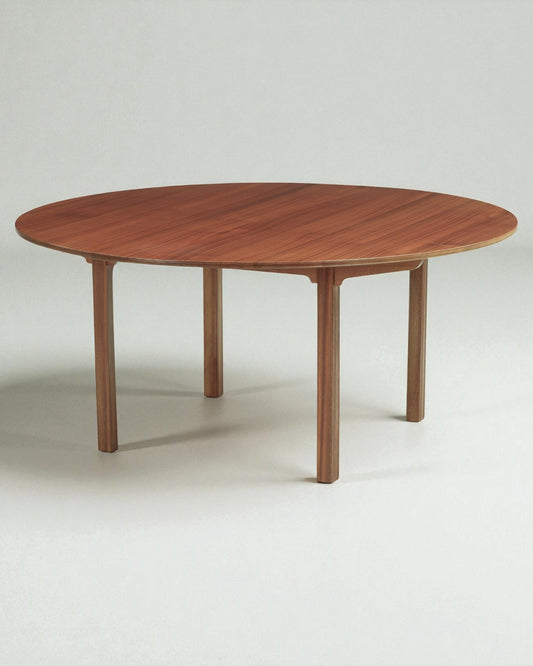
Our collection spans the most important decades of Danish design—from the 1930s through the 1960s—featuring rosewood, teak and hardwood tables by master designers and prestigious cabinetmakers such as Niels Otto Møller, R. Hansen, Christian Linneberg, N.V. Nielsen, Henry Rosengren Hansen, Bent Helweg-Møller, Rud Rasmussen, and Lysberg, Hansen & Terp. Each table has been chosen for its provenance, structural integrity, and design authenticity. Many come beautifully preserved and ready to grace a contemporary dining space; others are available for viewing before restoration, allowing customers to choose a finish that aligns with their aesthetic—whether subtle conservation or a full reinstatement of the original lacquer using historically faithful methods.
Paere Dansk’s expertise in rosewood, especially Brazilian rosewood from the mid-century period, underpins the uniqueness of our collection. This timber—now highly regulated and no longer available to produce new furniture—was once the material of choice for Danish designers seeking depth, richness and graphic beauty. The result is a generation of dining tables with unparalleled character.
Why Vintage Dining Tables Are More Relevant Than Ever
While dining tables from the mid-20th century were designed within the context of their time, they transition remarkably well into modern living. In fact, the qualities that defined them then—durability, thoughtful proportions, meticulous craftsmanship—are precisely what today’s interiors are rediscovering.
1. Built to Last a Lifetime (and Beyond)
Cabinetmakers of this era constructed tables using solid, slow-grown woods and traditional joinery. Many pieces feature runners, leaf mechanisms and legs assembled by hand, ensuring stability even under daily use for decades. Unlike many contemporary tables made from engineered composites or veneers, vintage Danish tables were designed for generational longevity.
2. Elegant Scalability for Contemporary Homes
Many of the mid-century tables Paere Dansk offers include extension leaves—sometimes concealed, sometimes separate—designed to transform a table from everyday family size to dinner-party ready. Designers like N.V. Nielsenand Henry Rosengren Hansen excelled in creating smooth, intuitive extension mechanisms that still function impeccably today.
3. Aesthetic Warmth and Timeless Proportion
Vintage Danish tables are deceptively simple. Their beauty lies in scaled legs, balanced overhangs, subtle edges and carefully arranged grain patterns. These details allow them to pair effortlessly with interiors ranging from Scandinavian minimalism to contemporary, eclectic and even industrial spaces.
4. Sustainable, Investment-Worthy Furniture
Choosing a vintage table is a commitment to sustainability—preserving a piece already crafted instead of purchasing a newly manufactured item. And because certain designers and rosewood models have become increasingly rare, many vintage dining tables represent solid long-term investments.
Key Designers & Cabinetmakers Featured in Paere Dansk’s Collection
Niels Otto Møller (1955–1969)
Møller’s dining tables epitomise sculptural clarity and impeccable craftsmanship. Designed in 1955, his medium-sized rosewood table (150×100 cm), produced until 1969 and labelled with the early JL Møller round metal mark, remains one of the most refined Danish tables of the era. Early examples—such as those held by Paere Dansk—display:
· Exceptionally dark, richly patterned rosewood, often compared to fine marbling
· Significant, beautiful patina, signalling decades of careful, natural ageing
· construction details aligned with Møller’s philosophy of integrity and precision
Tables from this era can be viewed in their original condition and restored as desired. Restoration typically involves removing old lacquer and applying a new, water-resistant finish—achieved without artificial colouring—allowing the customer to choose between a softer, character-led patina or a finish close to its 1960s appearance.
Møller’s tables pair harmoniously with vintage chairs from the same period, though their clean silhouettes make them compatible with almost any well-crafted seating.
R. Hansen (1955)
R. Hansen’s 1955 dining table is admired for its structural elegance and balanced design. Rosewood examples from pre-1970 stock are especially prized, particularly when the grain displays the long, linear figuring characteristic of the era’s finest lumber.
Paere Dansk offers rare opportunities to view these tables before restoration, enabling customers to appreciate untouched grain, original lacquer patterns and natural wear. Restoration can be minimal—light refinishing—or more complete, reinstating the table’s original pre-1970 clarity and depth.
Little-known fact: Hansen’s workshop was one of several smaller Danish studios in the 1950s that maintained traditional woodworking apprenticeships, ensuring each table passed through the hands of cabinetmakers with years of specialised training.
Christian Linneberg (1962–1969)
Linneberg’s small rosewood dining tables from the 1960s are masterclasses in proportion and grain selection. These pieces often feature:
· high-quality Brazilian rosewood with tight, symmetrical figuring
· subtle tapering that lifts the tabletop visually
· understated shaping typical of Danish design purity
The compact size of many Linneberg tables makes them perfect for apartments, modern kitchens or breakfast areas where space is at a premium without compromising on authenticity.
N.V. Nielsen (1940s & 1960s)
N.V. Nielsen stands out for his innovative Dutch extension mechanisms—ingenious sliding systems that store leaves within the body of the table. These tables, produced in both the 1940s and the 1960s, reflect evolving Danish tastes:
· 1940s versions often display Art Deco echoes and more decorative touches.
· 1960s versions lean fully into Danish modernism, with refined legs and cleaner geometry.
Made by Lysberg, Hansen & Terp, these tables are exceptionally well engineered, making them ideal for homes that need flexible seating without sacrificing design pedigree.
Henry Rosengren Hansen (1960s)
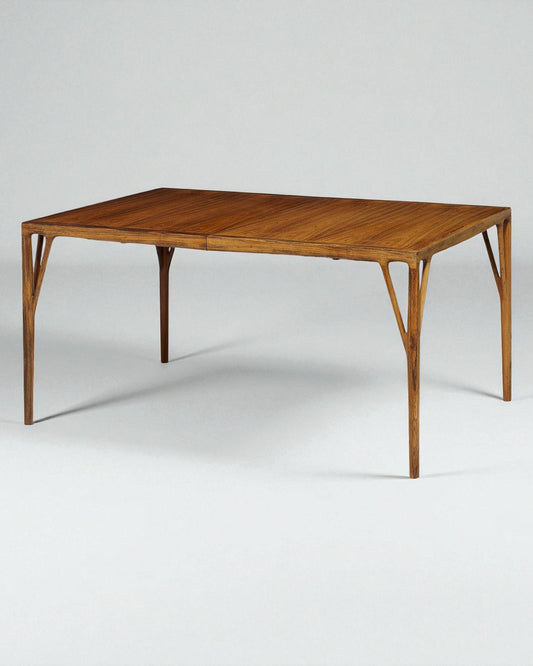
Rosengren Hansen’s rectangular dining tables with two leaves are renowned for their precision and functional beauty. His work represents the transition from organic 1950s design to the sharper, architectural lines of the 1960s.
Notable features include:
· Beautifully aligned veneer or solid rosewood grain
· Slim legs that retain strength through clever joinery
· Leaf extensions that integrate seamlessly
Rosengren Hansen’s tables are favourites among collectors for their versatility and purity of form.
Rud Rasmussen (1950s)
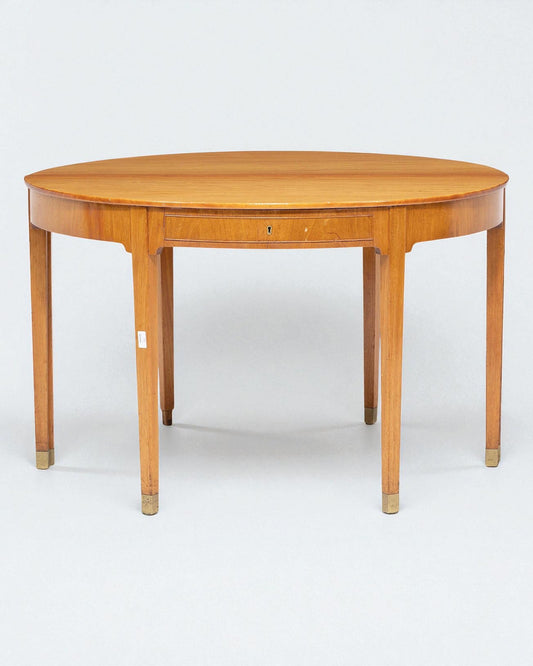
The pair of 1950s hardwood D-shaped centre tables with brass-tipped legs highlights Rud Rasmussen’s excellence as one of Denmark’s oldest and most respected cabinetmaking houses. Known for collaborations with Kaare Klint and other leading designers, Rasmussen’s workshop emphasised:
· Flawless joinery
· Exacting material selection
· Craftsmanship that often exceeded the design brief
The D-shaped format offers a beautifully soft silhouette, ideal for creating intimacy in dining spaces.
Bent Helweg-Møller (c.1930)
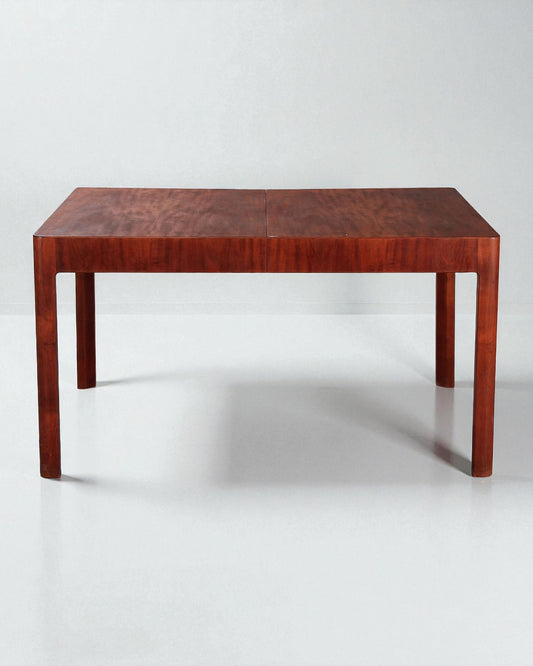
Helweg-Møller’s large rectangular dining table with three leaves represents an early step toward what would become Danish modernism. Crafted around 1930, this piece blends:
· Gentle Art Deco influences
· Emerging Scandinavian functionalism
· Long, elegant lines and generous extension capacity
This period table sits at a fascinating intersection between decorative craftsmanship and modern minimalism. It is a collectible piece with strong architectural presence.
The Rosewood Era: An Unrepeatable Moment in Furniture History
Rosewood dining tables created between 1955 and 1969 have a cult following—its use during this era marks a peak in Danish design. The wood’s natural characteristics include:
· Deep purples, umbers and chocolate tones
· High density and natural oils, offering exceptional durability
· Dramatic grain variation, often bookmatched for visual impact
Because sourcing of Brazilian rosewood ceased in later decades due to conservation measures, vintage tables from this era represent the final generation of true, old-growth rosewood furniture. Paere Dansk’s specialism in acquiring and restoring these pieces ensures they continue to thrive in modern homes.
Restoration is a critical component of preserving rosewood correctly. Paere Dansk’s process involves:
1. Removing degraded lacquer
2. Re-lacquering using historically accurate, water-resistant finishes
3. Preserving grain depth without artificial stains or colourants
Customers may opt for minimal intervention—maintaining character and patina—or a fully refreshed finish suitable for daily family use.
Why Vintage Dining Tables Integrate Seamlessly into Modern Life
Despite originating decades ago, vintage Danish tables remain remarkably attuned to contemporary living:
Flexible Form
Their dimensions suit urban apartments and large homes alike. Many tables expand significantly, making them ideal for entertaining.
Warm, Human-Centred Materials
Timber tones soften modern architecture, offering warmth against polished concrete, painted walls or contemporary lighting.
A Sense of History
A vintage table becomes a conversation piece, a centre of gravity in the home, and a reminder that craftsmanship matters.
Restorability & Longevity
Unlike many modern pieces, vintage tables can be restored indefinitely—sandable, refinished, structurally repairable.
Why Paere Dansk Is the Destination for Vintage Dining Tables
Paere Dansk brings together expertise, preservation philosophy and a deep love for Danish design. Our customers appreciate:
· Authenticity — every piece carefully sourced and vetted
· Choice — from untouched patina to fully restored finishes
· Craftsmanship — tables selected for structural quality and aesthetic distinction
· Specialism in rosewood, one of the rarest and most precious materials in Danish furniture history
Whether you seek a compact 1960s table for a Scandinavian kitchen, a statement rosewood piece for a dining room, or a historically significant early 20th-century design, Paere Dansk offers a collection shaped by passion, knowledge and respect for craftsmanship.